The Business Case for Limb Salvage: What Medical Device Companies Need to Know

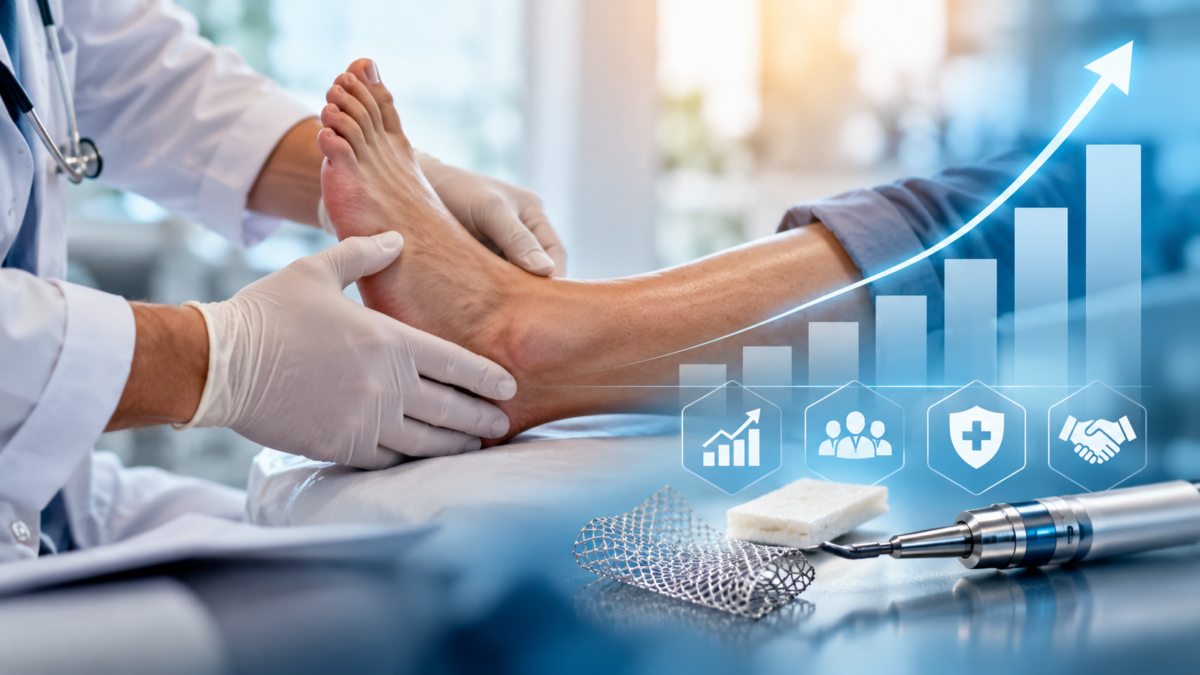
Medical device companies that position themselves around limb salvage can grow revenue, protect margins, and strengthen payer and provider relationships while directly reducing total cost of care for high‑risk patients. With the science of wound care advancing, lets discuss ways to maximize exposure and become a key industry player.
Why limb salvage is a business issue, not just a clinical one
Limb salvage sits at the intersection of three forces that every device manufacturer is already thinking about. First, the rise of value‑based care, second, increasing scrutiny on device spend, and third the shift toward integrated care pathways. Major device companies consistently generate profit margins in the 20–30% range, but those margins are increasingly tied to demonstrable impact on outcomes and total episode cost. Limb salvage is exactly the kind of high‑acuity, high‑cost domain where meaningful outcome improvements translate into visible financial value for hospitals, Integrated Delivery and specialty Networks, and payers.
At the same time, the global limb salvage systems market is expected to grow from about 2.1 billion USD in 2024 to roughly 3.4 billion USD by 2030. This marks a projected a steady compound annual growth rate that outpaces many mature device categories. For companies with portfolios in vascular, wound, fixation, orthobiologics, or podiatric surgery, limb salvage is not a just a niche, it is a natural organizing theme that integrates existing technologies into a multifaceted and economically defensible offering.
The economics of limb loss vs limb salvage
From the buyer’s perspective, the business case starts with the cost and trajectory of major amputation versus successful salvage. Major lower‑extremity amputation triggers immediate surgical and inpatient expense, but the true burden sits in downstream. Expenses for rehab, skilled nursing, prosthetics, readmissions, and loss of independence need to be considered. Limb salvage strategies aim to prevent that cascade by preserving a functional limb, maintaining ambulation, reducing hospitalization days. The desired result is avoiding amputations.
Evidence from multidisciplinary limb salvage programs, particularly vascular–podiatry alliances, shows that close collaboration can improve clinical outcomes and generate measurable economic value. Literature indicates that a podiatry–vascular limb salvage alliance, not only reduced amputation rates, but also delivered economic benefit through fewer complications, shorter length of stay, and lower readmission rates. For a hospital CFO or payer medical director, that is the core of the ROI narrative a device company needs to be prepared to quantify.
A simple way to frame this is to walk stakeholders through the individual steps, including baseline, intervention, and impact in a single episode of care. Start with the baseline, and calculate the costs of critical limb‑threatening ischemia or severe diabetic foot complications in the covered population. Look at the historic amputation rate, and the current episode‑of‑care cost. Then describe the intervention as the adoption of a structured limb salvage pathway (supported by your devices), whether endovascular, surgical, wound, fixation, or infection control. Show that once the care paradigm is implemented within a multidisciplinary team model, outcomes start to become apparent, quickly. Finally, quantify the impact in terms of reduced major amputations, improved limb salvage rates, shorter hospital stays, and fewer readmissions. This needs to be translated into per‑patient and per‑population savings over a one‑ to three‑year horizon. The more you can attach concrete numbers, even as well‑sourced ranges, to each of these steps, the stronger and more credible your business case will be.
Market and margin implications for device companies
On the top‑line side, the projected growth of limb salvage systems reflects both rising prevalence of diabetes and peripheral arterial disease, and greater institutional willingness to invest in limb‑preserving technologies. As the market moves from one‑off procedures toward longitudinal programs, companies that can anchor themselves as “limb salvage partners” rather than product vendors will be better positioned to capture share and cross‑sell across service lines.
On the margin side, quality and reliability are not optional. McKinsey’s work on the business case for medical device quality demonstrates that quality events such as product recalls, field actions, and performance failures, carry a much higher financial penalty than most organizations recognize. These costs including lost sales, remediation, legal costs, and reputational damage. In a limb salvage context, where failures can mean infection, re‑operation, or limb loss, the cost of quality lapses multiplies because it undermines the very economic story you are trying to tell.
For portfolio strategy and pricing, limb salvage gives you a clear rationale for premium pricing when you can credibly link product features to reduced complications, shorter OR time, or fewer revisions. It also creates an opportunity for bundled or pathway pricing across devices used by vascular surgery, podiatry, orthopedics, and wound care, aligned with DRGs or other value‑based arrangements. In addition, a strong limb salvage value proposition opens the door to risk‑sharing pilots. For example, supporting a limb salvage program in exchange for volume commitments tied to clinical metrics, can underwrite that risk with consistently strong quality performance.
What medical device companies specifically need to do
For a device organization, “knowing” the business case for limb salvage means operationalizing it across strategy, R&D, evidence, and commercial execution.
- Define your limb salvage thesis
Start by mapping where your current products touch the limb salvage journey. Look at the processes of screening and diagnostics, revascularization, infection control, skeletal stabilization, wound closure, offloading, and follow‑up. From there, decide whether you will position the business as a focused technology leader in a specific slice of that pathway (for example, below‑the‑knee endovascular) or as a broader systems partner that works across multiple specialties.
- Build a clinical–economic evidence platform
You can strengthen your evidence platform by creating, supporting or joining multidisciplinary limb salvage programs across a system, health group, or hospital. Bringing vascular, podiatry, and wound care together, allows you to prospectively collect outcomes and resource‑utilization data tied directly to your technologies. As you do that, design studies that capture not only limb salvage rates but also length of stay, readmissions, OR time, and post‑acute utilization. These are the variables that hospital and payer executives ultimately use to judge value.
- Align quality and product development with real‑world risk
Apply what we already know from broader analyses of device quality to tighten design controls, create protocols for post‑market surveillance, and field‑issue response. This must be done with particular rigor in high‑stakes limb salvage indications. From there, prioritize design features that reduce the failure modes most likely to cause infection, re‑operation, or delayed healing, and make sure you explicitly connect those features to economic outcomes in your clinical and commercial materials.
- Reframe commercial messaging and engagement
Equip your teams to lead with a limb preservation, and a total‑cost‑of‑care narrative. This should be anchored in your own data, referencing credible third‑party literature, rather than defaulting to commodity product comparisons. In parallel, develop practical tools that help hospital partners model the financial impact of a limb salvage program for their own system, incorporating market growth projections and their internal benchmarks, so the value story becomes specific, local, and actionable.
- Think in terms of programs, not products
Help customers design a true limb salvage service line. Create clear referral criteria, standardized protocols, multidisciplinary clinics, and rigorous data tracking, but make sure your devices are embedded as the enabling tool, rather than one‑off products. Then back that up with implementation support in the form of education, pathway templates, and outcomes dashboards that make it easier for a health system to launch, operationalize, and ultimately strengthen a limb salvage program using your portfolio.
Strategic advantages beyond immediate revenue
Companies that lead in limb salvage gain more than incremental device sales. They become central to how providers and payers think about a complex, chronic, high‑cost problem. That strategic positioning tends to yield early invitations into pilots for value‑based care, preferred‑partner contracts, and co‑branded centers of excellence. It also creates meaningful differentiation in a device industry where many product categories are increasingly commoditized and where quality, outcomes, and service are becoming the real basis of competition.
There is also a reputational component. Limb salvage is a domain where the human impact is highly visible, and judged by outcomes. Promoting preserving mobility, independence, and, in many cases, life expectancy are key drivers for natural interest. For boards, investors, and employees, it is often easier to rally around a strategy that can clearly articulate both economic return and human value. Limb salvage offers that combination in a way that few other device categories do.
Don’t know where to start? Let’s talk. Contact me directly to discuss your project and thoughts.